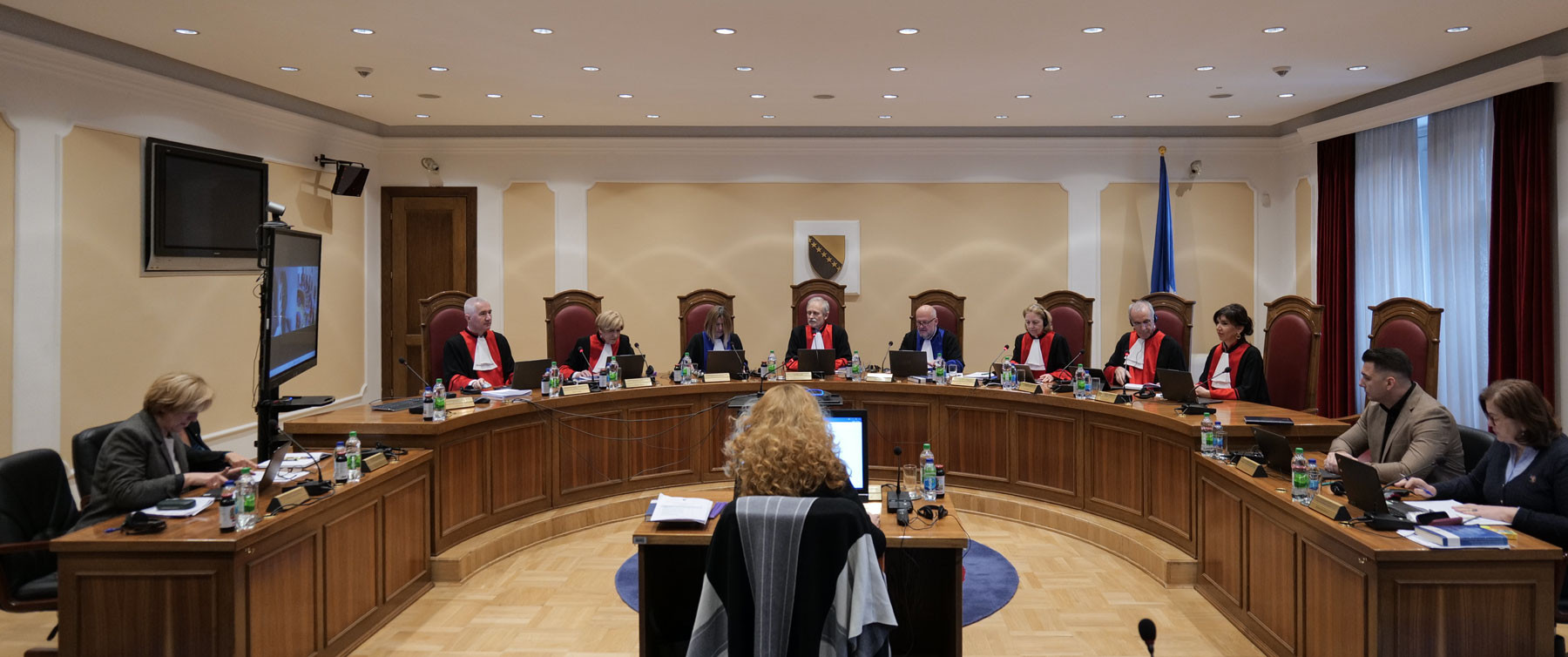
On 27 and 28 November 2025, the Constitutional Court of Bosnia and Herzegovina held its 164th plenary session at which it adopted decisions on requests for abstract review of constitutionality and a considerable number of appeals. The Constitutional Court also addressed issues of relevance to its work.
The Constitutional Court considered case no. U-29/25 (four requests/cases pertaining to the same constitutional issue joined) at this session. As the discussion was not closed, it will be continued at the next session and a decision adopted.
Of the decisions adopted at the plenary session, the Constitutional Court singles out the following:
U-26/25 – In this case, having deliberated on the requests filed by Mr. Denis Bećirović, Member of the Presidency of Bosnia and Herzegovina (BiH), and 14 Members of the House of Representatives of the Parliamentary Assembly of BiH for a review of constitutionality of the Conclusions concerning the Information relating to the decision of the Central Election Commission of BiH on the end of mandate of the Republika Srpska (RS) President Milorad Dodik no. 02/1-021-1012/25 adopted by the National Assembly of the RS at the 24th special session held on 22 August 2025, the Constitutional Court found that point no. 4, the first sentence of point no. 9 (point no. 7 following the amendments) and point no. 12 (point no. 10 following the amendments) of the Conclusions concerning the Information relating to the decision of the Central Election Commission of BiH on the end of mandate of the RS President Milorad Dodik no. 02/1-021-1012/25 are not compatible with Articles I(2), I(3), III(2)(a) and 5, III(3)(b) and VI(5) of the Constitution of BiH.
Pursuant to Article 61(1), (2) and (3) of the Rules of the Constitutional Court, point no. 4, the first sentence of point no. 9 (point no. 7 following the amendments) and point no. 12 (point no. 10 following the amendments) of the Conclusions concerning the Information relating to the decision of the Central Election Commission of BiH on the end of mandate of the RS President Milorad Dodik no. 02/1-021-1012/25 are rendered ineffective and shall cease to be in force as of the date of their adoption.
It was further decided that the procedure initiated upon the request of the applicants for a review of constitutionality of the second sentence of point no. 6 and points nos. 7 and 8 of the Conclusions concerning the Information relating to the decision of the Central Election Commission of BiH on the end of mandate of the RS President Milorad Dodik no. 02/1-021-1012/25 is discontinued because the disputed general act is no longer in force.
The requests of the applicants for a review of constitutionality of points nos. 1, 2, 3 and 5, the first sentence of point no. 6, the second sentence of point no. 9 and points nos. 10 and 11 of the Conclusions concerning the Information relating to the decision of the Central Election Commission of BiH on the end of mandate of the RS President Milorad Dodik no. 02/1-021-1012/25 have been rejected on the grounds that the Constitutional Court does not have jurisdiction.
The Constitutional Court decided that Decision on Interim Measure no. U-28/25 of 10 September 2025 shall be rendered ineffective.
In the reasons given in the decision, the Constitutional Court noted, inter alia, that in view of the fact that the decision of a competent State institution ended Milorad Dodik’s mandate as the RS President and called elections for that function, the Constitutional Court finds it indisputable that the rejection of the concrete judgment of the Court of BiH, the BiH CEC’s decision and the decisions of the Constitutional Court referred to in point no. 4 and the first sentence of point no. 9 of the Conclusions is in direct conflict with the obligation to comply with decisions of State institutions under Article III(3)(b) of the Constitution of BiH. In addition, such course of action is in violation of the principle of rule of law under Article I(2) of the Constitution of BiH according to which final and binding decisions of the institutions may not be reviewed but must be implemented. Namely, in this way the National Assembly, as a legislative authority, invalidates a final judgment of the Court of BiH and the decisions of, respectively, the BiH CEC and the Constitutional Court. In this way, the principle of separation of powers, as an inherent segment of the rule of law, is violated because an Entity legislature interferes with the powers of the State judiciary as the other branch of government independent of the legislative branch, as well as with the powers of the Constitutional Court as an independent controller of the three pillars of government (legislative, executive and judicial) and guardian of the Constitution of BiH.
It was further noted in the reasons that the Constitutional Court has already established in its case-law that the Entities do not have the right to self-determination under the Constitution of BiH which would permit self-organisation and territorial separation as that contradicts Article I(3) and Article III(2)(a) and (5) of the Constitution of BiH, and that position is final and binding within the meaning of Article VI(5) of the Constitution of BiH. Nevertheless, despite that, under point no. 12 of the disputed Conclusions, the National Assembly Collegium is tasked with preparing the text of a Resolution on the self-determination of the Serb people and the RS. The stated reasons are sufficient for the Constitutional Court to find that point no. 12 of the Conclusions is incompatible with Article I(3), Article III(2)(a) and (5) and Article VI(5) of the Constitution of BiH.
AP-3217/21 (Bosnia and Herzegovina) - In this case, the Supreme Court of the Republika Srpska (RS), by the disputed decisions, violated the appellant's right to a fair trial under Article II(3)(e) of the Constitution of Bosnia and Herzegovina when it arbitrarily interpreted the relevant provisions of the RS Law on the Maintenance of Land Surveys and Cadastres, the RS Law on Survey and Cadastre and the RS Rulebook Law on the Maintenance of Land Surveys and Cadastres and when it found that the appellant, in terms of the aforementioned regulations, failed to identify the disputed real properties according to the data recorded in the cadastral records. In addition, the Supreme Court violated the appellant’s rights, when it found that the conditions for the registration of ownership rights were not met because no land registers or real properties cadastre were established for the disputed real properties.
AP-3144/21 (Alija Hadžiabdić) – In this case, the Constitutional Court found that there has been a violation of the appellant’s right under Article II(3)(b) of the Constitution of BiH and Article 3 of the European Convention. Namely, while it was beyond dispute that the appellant as an oncological patient cannot receive proper medical care at the Tuzla Correctional Facility, the relevant authorities did not refer him to hospital treatment. Instead, the appellant continued serving his prison sentence.
AP-3318/21 (M. L.) – In this case, the Constitutional found that the appellant’s right under Article 7(1) of the European Convention has been violated, as in the present case the application of the Criminal Code, according to which the appellant’s request for replacing prison sentence with a fine was dismissed, operated to the appellant’s detriment and affected the very “penalty” imposed, and not its execution.
AP-701/22 (Biljana Stevanić) - In this case, the Constitutional found that that there has been a violation of the right to private life because the public authorities failed to fulfil their positive obligation to protect the appellant’s private life because they failed to conduct an effective investigation into the appellant’s allegations of committed violence.
All the decisions adopted at the plenary session will be communicated to the applicants/appellants within one month and will be published on the website of the Constitutional Court of Bosnia and Herzegovina in due course.