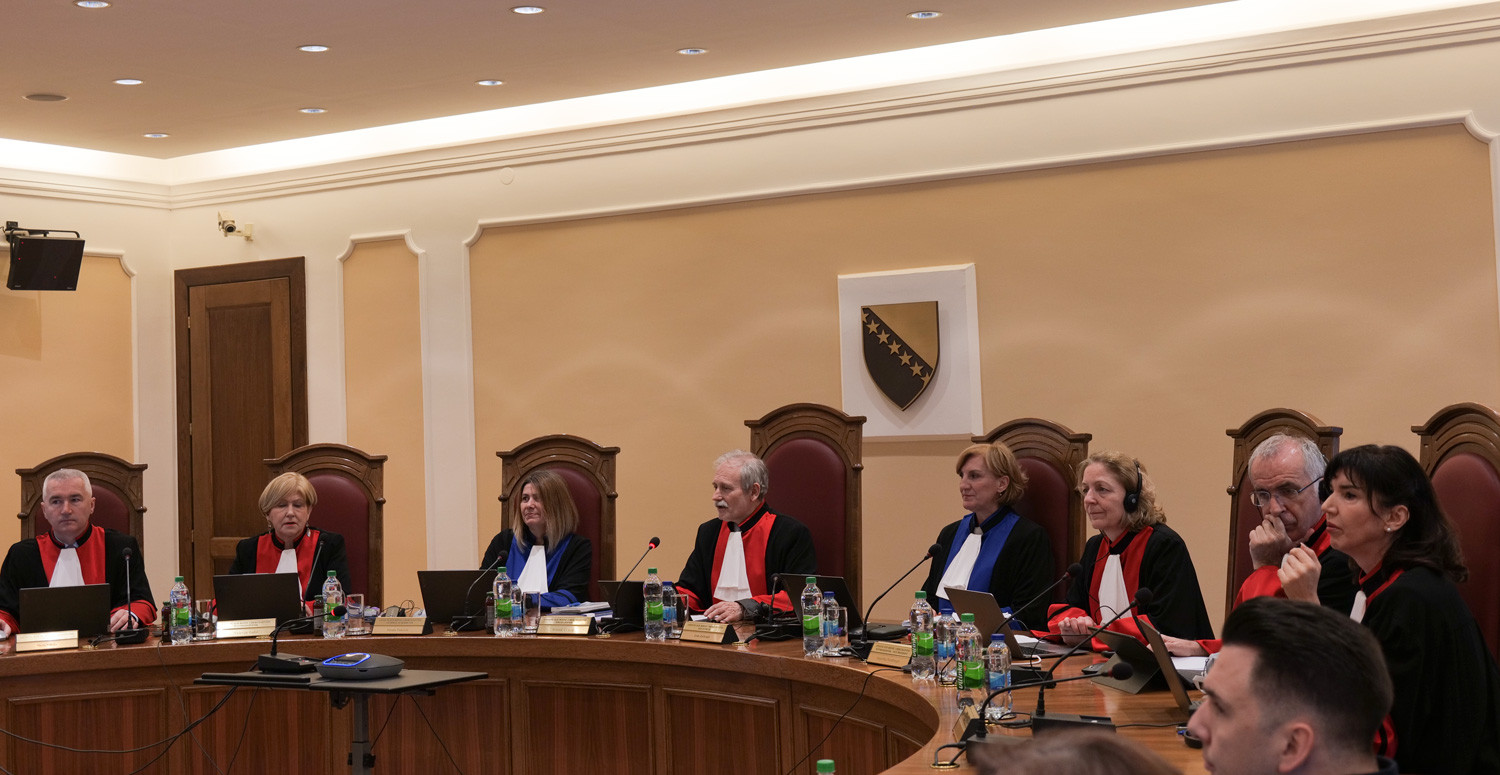
On 22 and 23 January 2026, the Constitutional Court of Bosnia and Herzegovina held its 166th plenary session, at which it decided requests for constitutional review and a number of appeals.
Of the decisions adopted at the plenary session, the Constitutional Court singles out the following:
U-29/25 – In this case, the Constitutional Court considered a request of eleven members of the House of Representatives of Bosnia and Herzegovina, the First Deputy Chair of the House of Peoples of the Parliamentary Assembly of Bosnia and Herzegovina and another eleven members of the House of Representatives of the Parliamentary Assembly of Bosnia and Herzegovina, seeking review of constitutionality and a determination of a dispute between Bosnia and Herzegovina and the Entity of Republika Srpska concerning the adoption of the Decision on the Appointment of the Prime Minister of the Republika Srpska (Official Gazette of the Republika Srpska, 78/25), the Decision on the Appointment of the Members of the Government of the Republika Srpska (Official Gazette of the Republika Srpska, 78/25), the Decision on the Early Entry into Force of the Decision on the Appointment of the Prime Minister of the Republika Srpska (Official Gazette of the Republika Srpska, 78/25), and the Decision on the Early Entry into Force of the Decision on the Appointment of the Members of the Government of the Republika Srpska (Official Gazette of the Republika Srpska, 78/25). The Constitutional Court has found that, in the present case, there exists a constitutional dispute concerning the question of whether, on the basis of the decisions of the Court of Bosnia and Herzegovina and the Central Election Commission of Bosnia and Herzegovina, Milorad Dodik could have held the mandate to, in his capacity as the President of the Republika Srpska, nominate the Prime Minister and the members of the Government of the Republika Srpska, which undeniably raises the issue of the rule of law as an issue under Article I(2) of the Constitution of Bosnia and Herzegovina. Furthermore, having regard to the aforementioned decisions of the Court of BiH and the Central Election Commission of BiH, the Constitutional Court has noted that the constitutional dispute also concerns the issue of compliance with the decisions of the institutions of Bosnia and Herzegovina, which is regulated under Article III(3)(b) of the Constitution of Bosnia and Herzegovina, Accordingly, the Constitutional Court has found that, in that respect, it has jurisdiction, since the acts in question raise the issue of compliance with Articles I(2) and III(3)(b) of the Constitution of Bosnia and Herzegovina, which is under the exclusive jurisdiction of the Constitutional Court. As to the merits of the case, the Constitutional Court has found that the contested decisions, in the period from their adoption on 2 September 2025 to their quashing on 18 January 2026, were contrary to Articles I(2) and III(3)(b) of the Constitution of Bosnia and Herzegovina, as they were adopted based on the Decision on the proposal of a candidate for the Prime Minister of the Republika Srpska issued by Milorad Dodik on 23 August 2025, even though his mandate as President of the Republika Srpska had terminated on 12 June 2025, the date on which the decision of the Court of Bosnia and Herzegovina became final, which had the legal consequence of terminating the mandate of the President of Republika Srpska, a fact that was only subsequently declaratorily confirmed in proceedings before the CEC BiH.
U-41/25 – In this case, the Constitutional Court considered a request of Kemal Ademović, Chair of the House of Peoples of the Parliamentary Assembly of Bosnia and Herzegovina, with the Constitutional Court of Bosnia and Herzegovina, seeking a review of the regularity of the procedure, determining the existence of a constitutional basis for declaring the following proposed decisions detrimental to the vital interest of the Serb people: the Proposed Decision on the Amendments of the Decision on the Appointment of Members of the Parliamentary Assembly of Bosnia and Herzegovina to the Stabilization and Association Parliamentary Committee between the Parliamentary Assembly of Bosnia and Herzegovina and the European Parliament, No. 02-34-1-2339/25 of 20 November 2025 (the first proposed decision), the Proposed Decision on the Amendments of the Decision on the Appointment of Members of the Parliamentary Delegation, no. 02-34-1-2337/25 of 20 November 2025 (the second proposed decision), and the Proposed Decision on the Amendments of the Decision on the Appointment of Members of the Inter-parliamentary Friendship Groups of the Parliamentary Assembly of Bosnia and Herzegovina for Bilateral Cooperation with the Parliamentary Bodies of Other Countries, no. 02-34-1-2338/25 of 20 November 2025 (the third proposed decision). According to the first proposal, Nenad Vuković was proposed, instead of Snježana Novaković – Bursać, to be appointed as Chairperson of the Stabilisation and Association Parliamentary Committee between the Parliamentary Assembly of BiH and the European Parliament. It was proposed in the second proposal that Nenad Vuković be appointed, instead of Snježana Novaković – Bursać, as a member of the Delegation of Parliamentary Assembly of BiH to the Parliamentary Assembly of the Council of Europe. It was proposed in the third proposal that, instead of Snježana Novaković-Bursać, Nenad Vuković be appointed as a member of the inter-parliamentary friendship groups of the Parliamentary Assembly of BiH for bilateral cooperation with the parliamentary bodies of other countries.
The Constitutional Court has established in that decision that the Statements of the Caucus of the Serb People in the House of Peoples of the Parliamentary Assembly of Bosnia and Herzegovina regarding the destructiveness of the vital interest of the Serb people in relation to the First, Second and Third Proposal meet the requirements of procedural regularity under Article IV(3)(f) of the Constitution of Bosnia and Herzegovina. The Constitutional Court has further established that the mentioned proposals do not violate the vital interest of the Serb people in Bosnia and Herzegovina. In the reasons for its decision, the Constitutional Court has noted, inter alia, that the signatories of the Statement did not explain how the appointment of Nenad Vuković, a delegate from the Serb People Caucus, would impede the effective participation of the Serb people in the joint bodies of the Parliamentary Assembly. In this regard, the signatories of the Statements did not explain how the appointment of Nenad Vuković would fail to ensure that the composition of the delegations reflects the overall balance of the House, as required by Article 180(2) of the Rules of Procedure of the House, or how such a composition could undermine the vital interest of the Serb people. Accordingly, since the proposed appointments maintain the representation of the Serb people in the joint delegations of the Parliamentary Assembly, the Constitutional Court finds that the proposed appointments ensure the effective representation of the Serb people in these joint delegations of the Parliamentary Assembly. Finally, the Constitutional Court has concluded the contested proposals do not raise an issue that may be regarded as a matter of vital national interest under Article IV(3)(f) of the Constitution of Bosnia and Herzegovina. Accordingly, the Constitutional Court holds that the claims of the majority of delegates from the Serb People Caucus that the first, second, and third proposals are detrimental to the vital interest of the Serb people are ill-founded.
AP-3059/21 (Zdravka Kraljević and Others) – in this case, the Constitutional Court has found a violation of the right under Article II(3)(a) of the Constitution of Bosnia and Herzegovina and Article 2 of the European Convention on Human Rights and Fundamental Freedoms due to the public authorities’ ineffectiveness of the investigation in the missile attack in Ljubuški in 1992, when the close relatives of the appellants were killed. Having regard to the overall duration of this investigation (the investigation has not been concluded 33 years after the event occurred), the Constitutional Court ordered the Prosecutor’s Office of Bosnia and Herzegovina to take all available measures and steps without delay to bring the investigation to a conclusion, with a view to ensuring compliance with the guarantees provided under Article II(3)(a) of the Constitution of Bosnia and Herzegovina and Article 2 of the European Convention on Human Rights and Fundamental Freedoms.
All decisions adopted at the plenary session will be communicated to the appellants/applicants no later than one month following their adoption and will be published on the website of the Constitutional Court of Bosnia and Herzegovina.