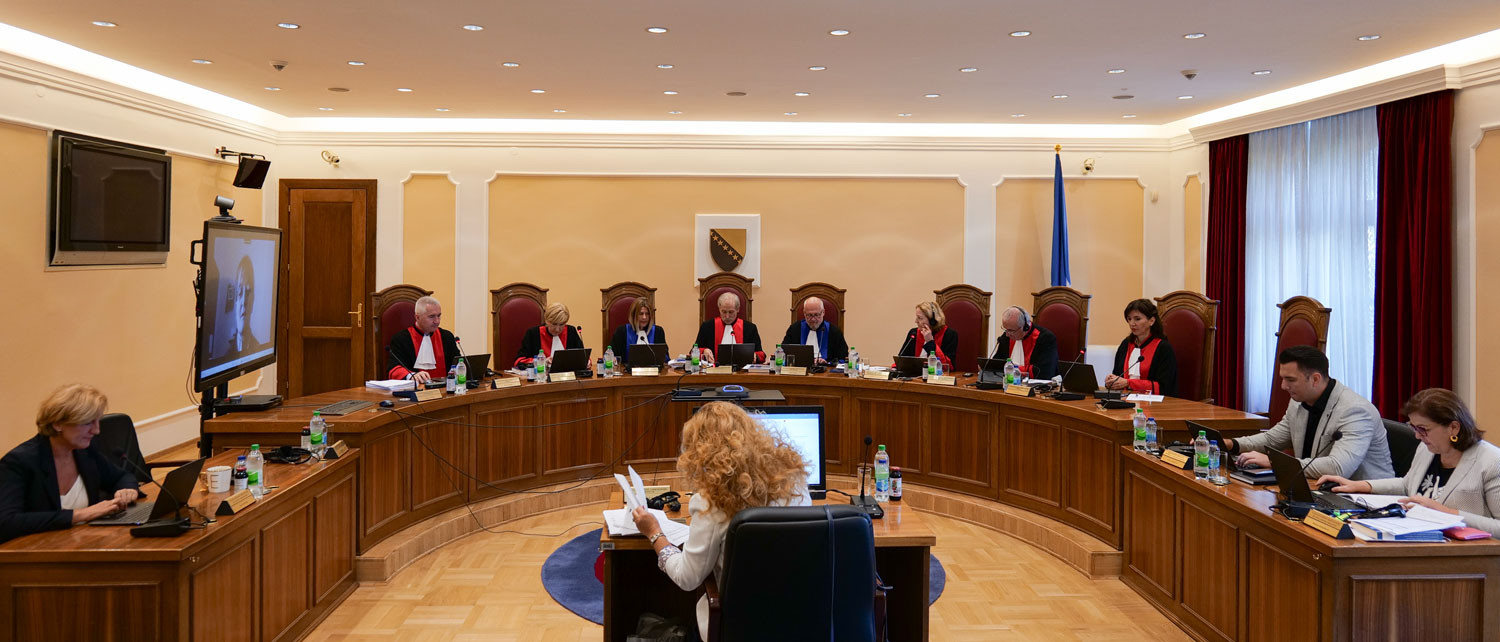
On 25 and 26 September 2025, the Constitutional Court of Bosnia and Herzegovina held its 162nd plenary session, at which it decided requests for constitutional review and a number of appeals. The Constitutional Court also decided other issues relevant to the work of the Constitutional Court.
Of the decisions adopted at the plenary session, the Constitutional Court singles out the following:
U-18/25 – In this case, the Constitutional Court, having considered a request of the Court of Bosnia and Herzegovina (Judge Samra Akova) seeking a review of compatibility of Article 104(1), as read with Article 43(2) of the BiH Institutions’ Labour Law (Official Gazette of Bosnia and Herzegovina, 26/04, 7/05, 48/05 and 50/08 - Final Provisions of the Law on Salaries and Remunerations in the Institutions of BiH, 60/10, 32/13, 93/17 and 88/23), found that the contested provision was not compatible with Article 1 of Protocol No. 12 to the European Convention for the Protection of Human Rights and Fundamental Freedoms because the differential treatment of the employees of the BiH institutions in exercising the right under Article 43(2) of the Labour Law as per the place of residence constituted discrimination that did not have reasonable and objective justification.
AP-1436/21 (Bosnia and Herzegovina) – In this case, the Constitutional Court decided, among other things, that the Supreme Court of the Republika Srpska, by the contested decision, had violated the appellant's right to a fair trial because that court had arbitrarily interpreted the relevant provisions of the Law on the Maintenance of Cadastral Surveys and Land Cadastre and the Rulebook for maintaining land surveys and cadastres in finding that the appellant had not fulfilled the legal requirements for registering a change of right to possession in the cadastral record. In addition, the Constitutional Court found a violation of the appellant's right to equality of the parties before the court because the appellant had not had equal treatment under procedural law since it, as the opposite party in the proceedings, had not been informed of the participation of an intervening party in the proceedings. In addition, the responses to the lawsuit and to the request for an extraordinary review of the court decision that was submitted by that intervening party were not delivered to the appellant.
AP-1533/21 (Radio-Television of the Federation of Bosnia and Herzegovina, Nevzeta Koljenović, Merila Dizdarević and Hasan Gabela) – In this case, the Constitutional Court found that the appellants’ right to freedom of expression had been violated in that the ordinary courts, in the circumstances of the present case, had failed to strike a fair balance between the appellant’s right to freedom of expression and the plaintiff’s right to reputation by obliging the appellants to pay non-pecuniary damages and because the response of the ordinary courts was not proportionate to the legitimate aim sought to be achieved, and was not necessary in a democratic society. The Constitutional Court holds among other things that the appellants, in a political show “Mreža”, informed the public about a topic of public interest (demolition of the Aladža Mosque in Foča in August 1992) professionally and in accordance with journalistic standards, talking to several interviewees and verifying information they received.
AP-2368/21 (Party of Democratic Progress - PDP) – In this case the Constitutional Court concludes that there has been no violation of the appellant’s right to a fair trial because in the disputed decisions the ordinary courts, when referring to relevant provisions of the Law on Obligations and the Election Law, gave clear reasons in support of the groundlessness of the appellant’s claim seeking restitution of the funds invested in the election campaign and compensation. The Constitutional Court does not find arbitrariness in the given reasons. Specifically, the appellant based its claim on the contract the appellant and the respondent, M. P., entered into in 2012, whereby they regulated their rights and obligations on the subject of funding the respondent’s running as a political candidate and his withdrawal from the appellant’s membership. The Constitutional Court observes that the ordinary courts reasoned in detail as to why the Contract concluded by the appellant and the respondent was null and void. Specifically, the courts gave detailed reasons in support of their finding that the subject of the contract in question was not permitted within the meaning of relevant provisions of the Law on Obligations and the Election Law.
AP-2400/21 (Vjekoslav Kantoci) - In this case the Constitutional Court concludes, inter alia, that there has been a violation of the right to a trial within a reasonable time, as a segment of the right to a fair trial, because the proceedings that were not complex lasted more than 20 years. This was resulting largely from the multiple remittals of the case for retrial, as well as the length of the proceedings before the first instance authority and before the Supreme Court.
AP-2942/25 - (Public Institution University of Zenica) – In this case the Constitutional Court concludes that there has been a violation of the appellant’s right to a fair trial (right of access to court) because the Cantonal Court in Zenica (the Cantonal Court), having applied Article 17(4) of the Law on Administrative Disputes of the Federation of BiH with excessive formalism, rejected the appellant’s request for stay of execution of the decision of the Ministry of Education, Science, Culture and Sport of Zenica-Doboj Canton (“the Ministry of Education”) of 9 June 2025 (annulling a decision of the Senate of the appellant of 3 June 2025), because the appellant failed to submit “written proof in the form of a confirmation or certificate” that it had not previously sent the same request for suspension of the decision to the Ministry of Education. The Constitutional Court notes that the appellant enclosed proof with its request that it had not sent the same request to the Ministry of Education. Among the proofs the appellant submitted was a request filed with the Ministry of Education on 17 June 2025 seeking issuance of a certificate that it had not submitted a request to that authority to suspend the disputed decision (not granted). The Constitutional Court observes that the Cantonal Court did not take this evidence into account at all; instead, it explicitly requested the submission of a confirmation or certificate issued by the Ministry of Education. However, the Ministry of Education did not issue such a confirmation at the appellant’s request.
All decisions adopted at the plenary session will be delivered to the applicants/appellants within one month and published as soon as possible on the website of the Constitutional Court of BiH.