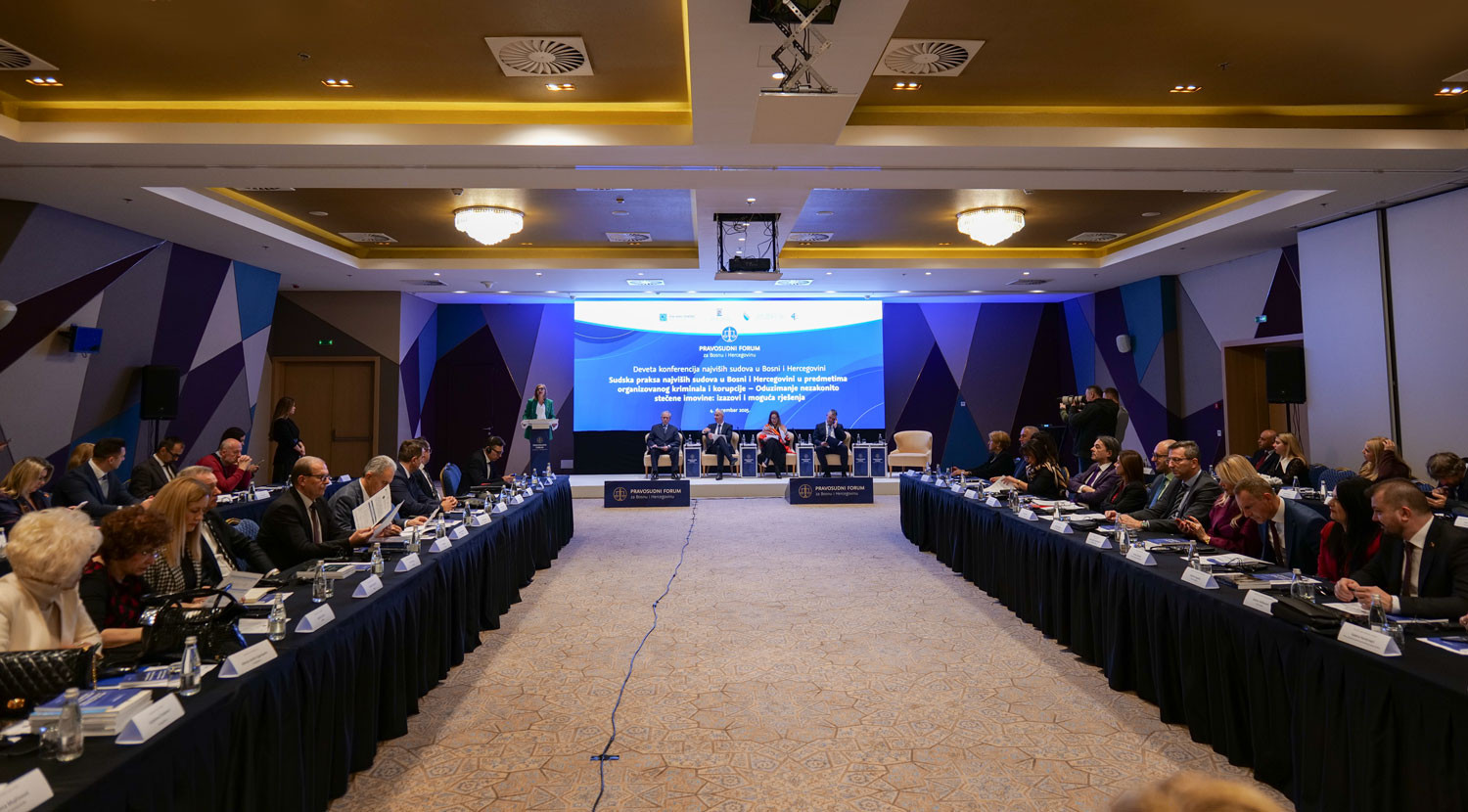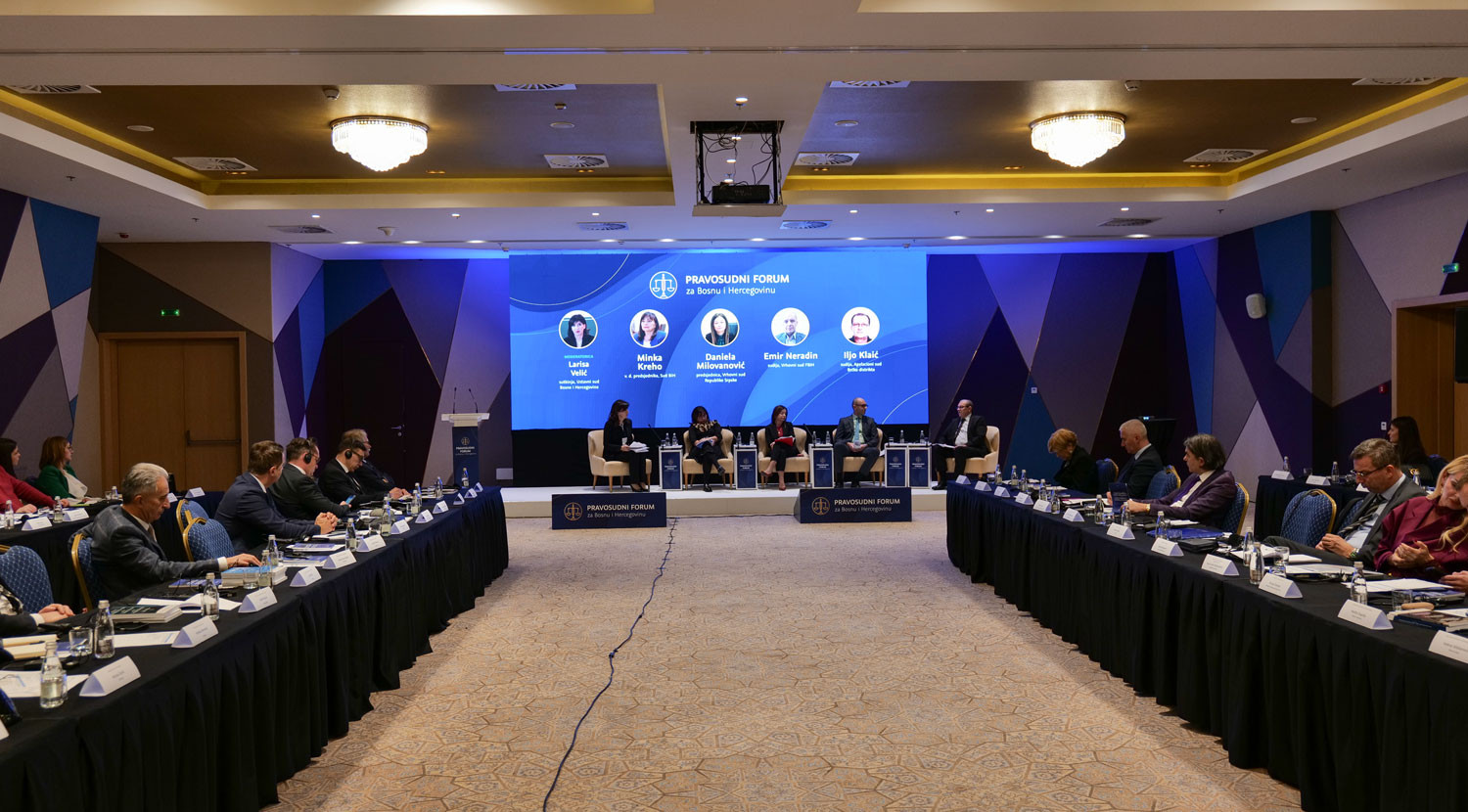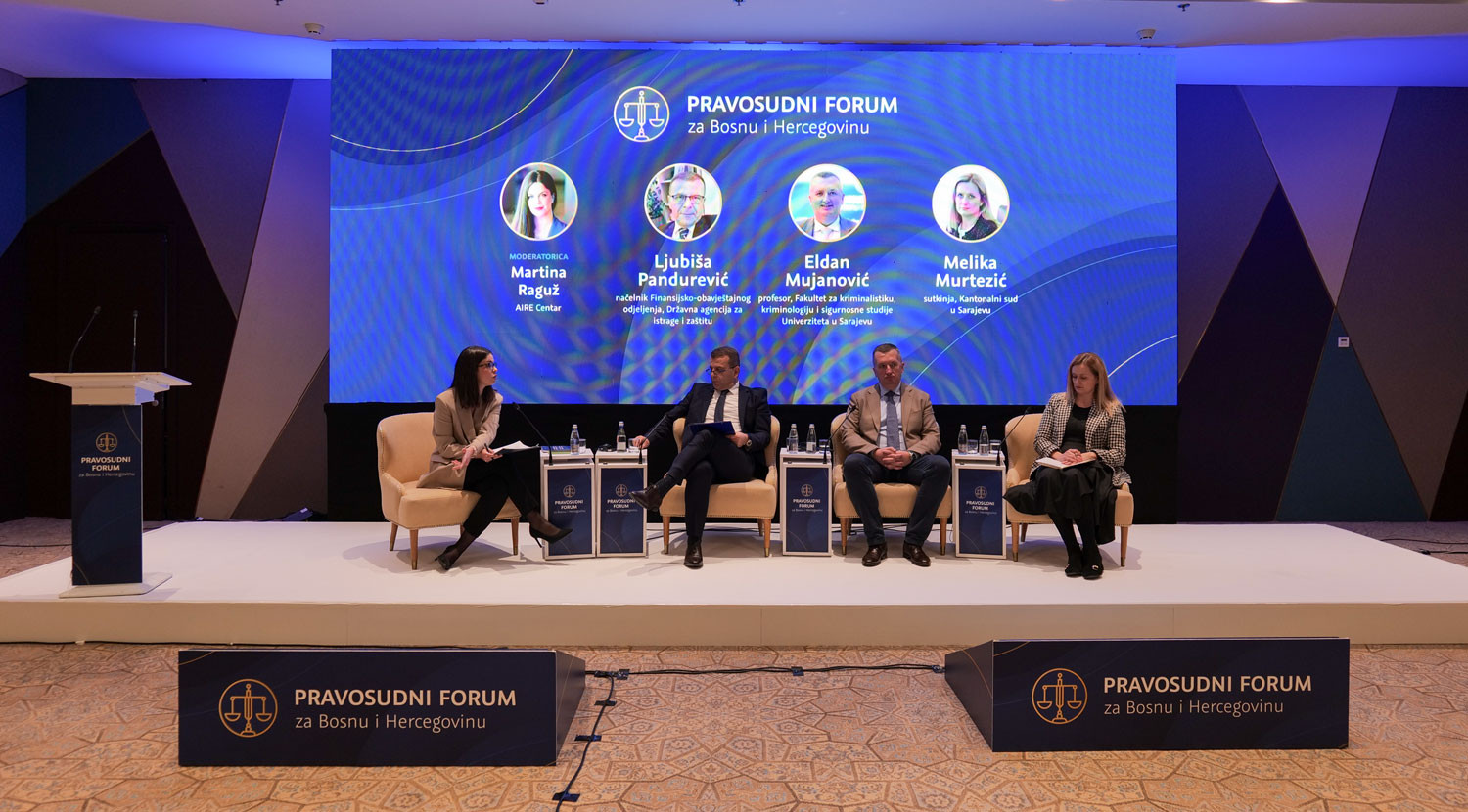
The Ninth annual conference was held in Sarajevo today within the framework of the Judicial Forum for Bosnia and Herzegovina on the topic entitled “Confiscation of Crime Proceeds in the Focus of the Judiciary of Bosnia and Herzegovina”.
While criminal groups in Europe generate more than one hundred billion euro annually, institutions in Bosnia and Herzegovina, as well as in major part of the EU, manage to confiscate only a small portion of crime proceeds. For that very reason this year’s Judicial Forum for BiH focused on the issue of a more efficient confiscation of assets – one of the most important, but also the most intricate mechanisms in the fight against criminal networks.
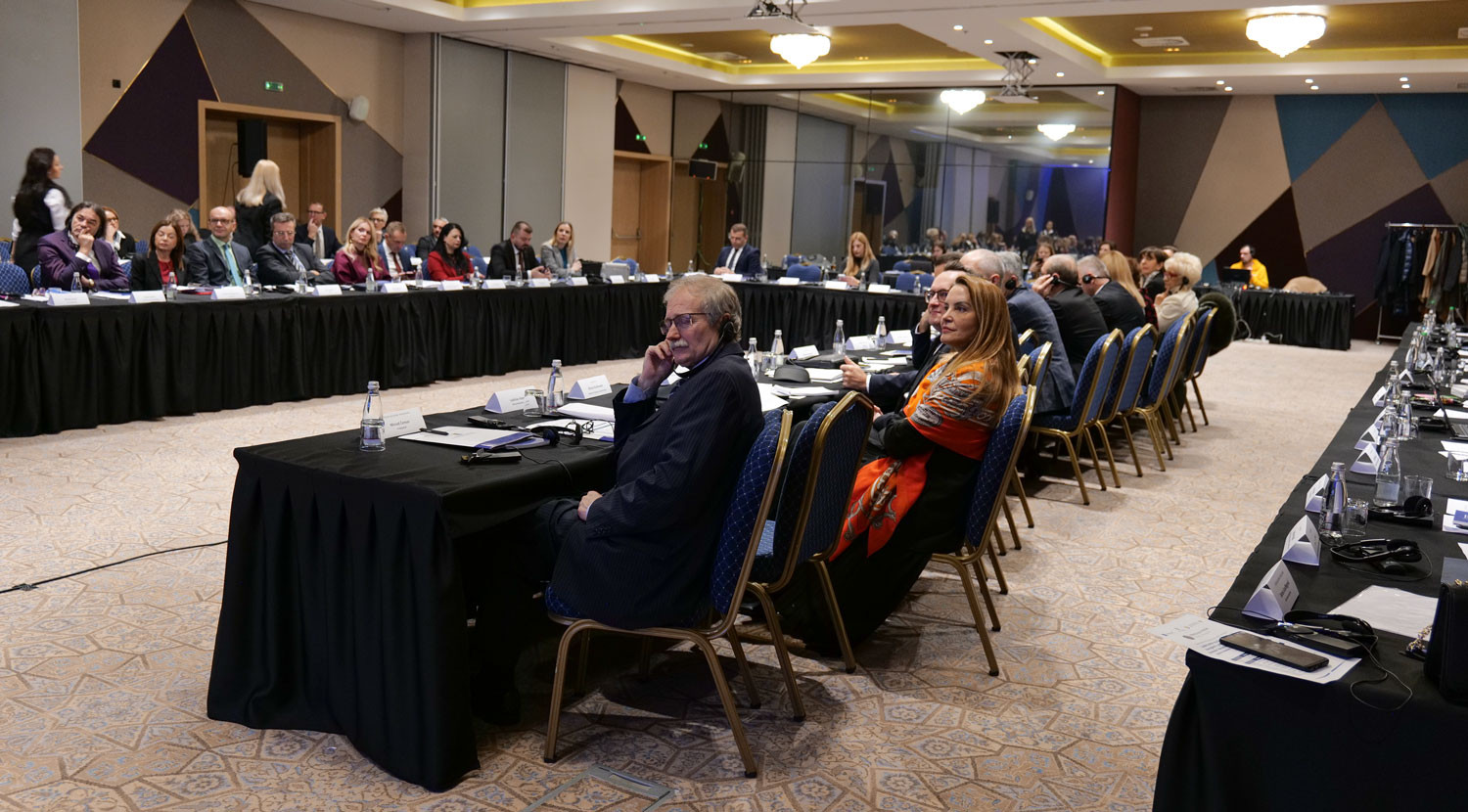
The Forum in Sarajevo brought together more than 70 representatives of the highest judicial institutions, prosecutor’s offices, ministries, international organisations and civil society from BiH and Europe. The organisers were the Constitutional Court of BiH and AIRE Centre – Western Balkans Programme, in cooperation with the High Judicial and Prosecutorial Council of BiH (HJPCBiH).
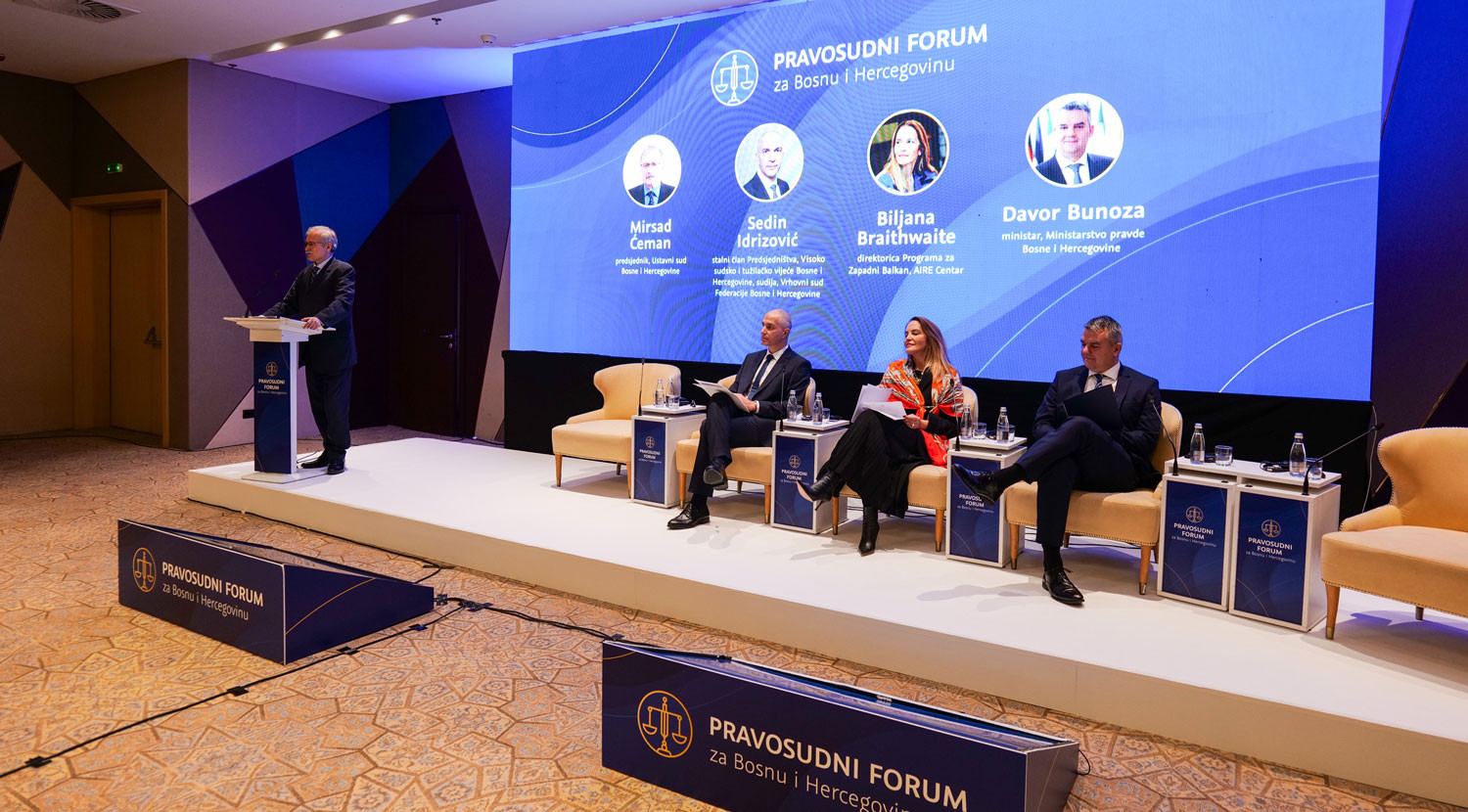
At the opening of the event, Mr. Mirsad Ćeman, President of the Constitutional Court of BiH, stated that the strengthening of the rule of law was the foundation of every stable society, and confiscation of assets one of its key pillars.
“This institution, as a special criminal law measure, is a preventive mechanism that sends a strong message that irresponsible, illegal or corrupt behaviour will not pay. Not to anyone, not ever. Consequently, such ‘threat’, let us call it like that, especially if implemented consistently, is in the function of the general and the special deterrence, which is, actually, ratio legis of criminal sanctions and measures in this segment as well”, said the President of the Constitutional Court of BiH.
Ms. Biljana Braithwaite, Director of the Western Balkans Programme of AIRE Centre, emphasised that the Forum constituted a unique platform bringing together presidents of the highest judicial institutions at the same table. In the focus of the discussion were also the findings from the latest Bosnia and Herzegovina Progress Report in which the European Commission warned that financial investigations and asset seizures and confiscations remained insufficient, which constituted a serious obstacle to the fight against criminal networks, but also to the compliance with the obligations on the EU path.
“For that reason, today we discuss how to confiscate the acquired assets efficiently, since the challenges are numerous. The investigative capacities are insufficient, punishments often do not have a deterring effect, whilst the extended confiscation is seldom applied. All of that hinders disruption of criminal networks and affects public trust”, Ms. Braithwaite said.
She noted that the European Commission sent a clear message that the coming year had to bring concrete results to BiH, not just plans. “Bosnia and Herzegovina is expected to make three key breakthroughs: establish specialised multi-agency teams, set up a state asset recovery office and considerably strengthen financial investigations”, Ms. Braithwaite concluded.
“For a number of years now, the HJPC BiH, as the regulatory body of the judiciary in BiH, has been working actively on creating appropriate strategic and operational measures in order to ensure a lawful, faster and more efficient conduct of judicial institutions in the fight against corruption”, stressed Mr. Sedin Idrizović, permanent member of the Presidency of the HJPC BiH and Judge of the Supreme Court of the Federation of Bosnia and Herzegovina.
He emphasised that, among other steps, the HJPC BiH adopted a new comprehensive training module developed especially for a more efficient processing of organised crime and corruption cases.
“This training encompasses key elements that concern the understanding of the structure and legal framework of organised crime and corruption, the role of a judge in the conduct of the proceedings with emphasis on procedural discipline and efficiency, but also the issue of confiscating illegally acquired assets. By its adoption, the HJPC has laid an important foundation for a more consistent, professional and faster work on the most complex cases of our judiciary”, Judge Idrizović added.
He also emphasised the importance of the work of the Case-Law Harmonisation Panel for the discussing and harmonising the positions in organised crime and corruption cases, and the Judicial Forum’s contribution in this area.
Mr. Davor Bunoza, Minister of Justice of Bosnia and Herzegovina, pointed out in his opening remarks that the key to regaining public trust in the judiciary was to show concrete results in the fight against corruption and organised crime, starting from the strengthening of the integrity of the judiciary and the holders of public offices. He stressed that for that very reason strict laws were adopted, from the amendments to the Law on the HJPC and the Law on Conflict of Interest to the imminent adoption of the Law on the Confiscation of Illegally Acquired Assets at the level of BiH, and that a full application of the Agreement with Eurojust was also expected soon. The Minister emphasised that despite the complex political relations, Bosnia and Herzegovina must continue on the path of EU integration and implement demanding reforms of judiciary, while the Ministry of Justice of BiH remained committed to the cooperation with judicial institutions and international partners.
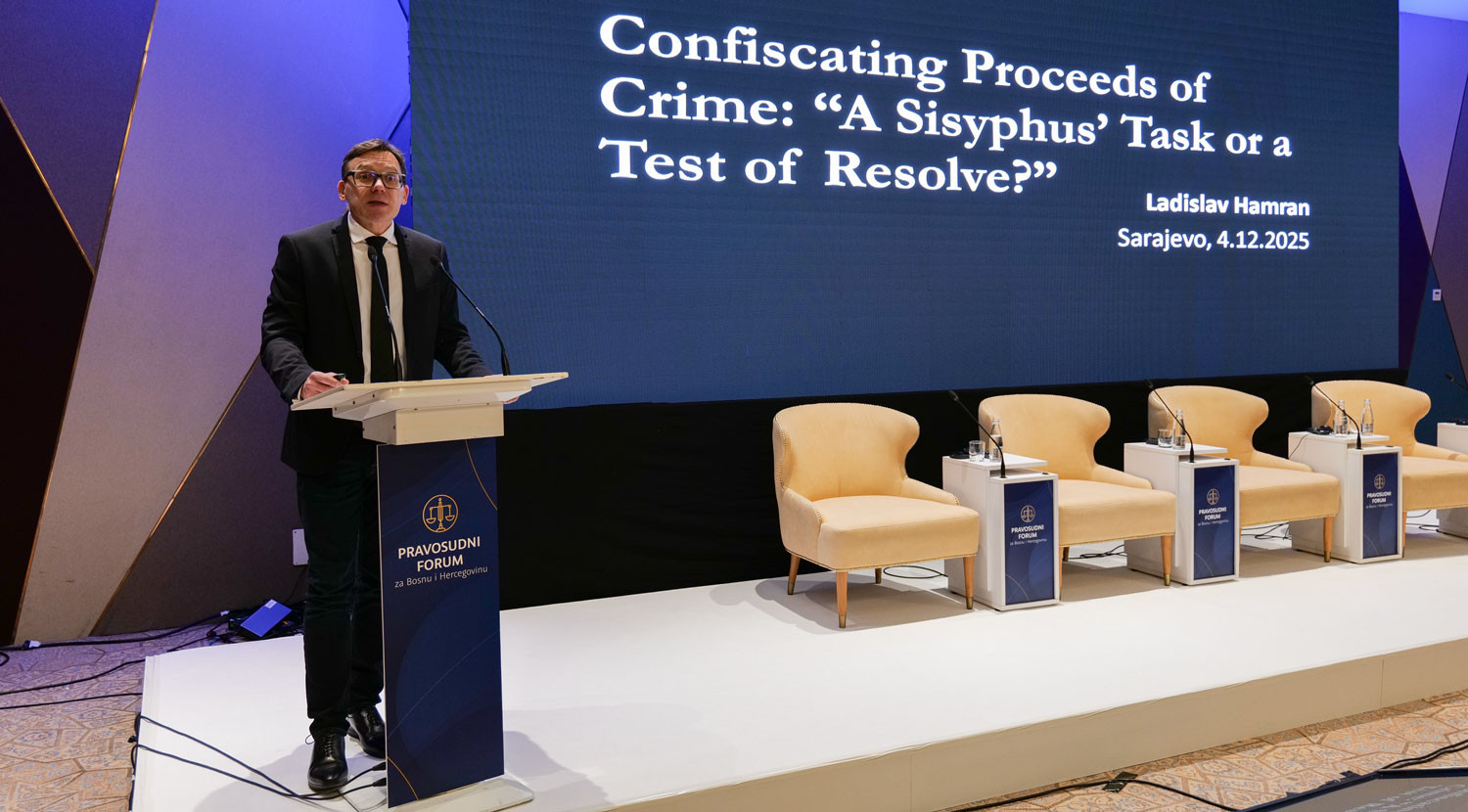
Key note speech was given by Mr. Ladislav Hamran, former President of Eurojust, who warned that fight against organised crime in the whole Europe faced advanced technological changes and sophisticated methods of hiding assets. As he stressed, criminal networks kept on adjusting whereas the institutional systems often remained slow and fragmented.
“Every time we adopt a better law, procedure or practice, a new cryptocurrency emerges, a new offshore haven or a new technology appears which changes the manner in which criminals operate. That is why we must look for an answer in the strengthening of the capacities, coordination and trust between the institutions”, Mr. Hamran said.
He emphasised that the problem was not restricted to BiH only, but was present throughout Europe. He presented the data according to which organised crime in the EU generates around 139 billion euro annually, whilst only about 2% of the criminal profits are frozen and only 1% finally confiscated. “This means that 99% of illegal profits stay in criminal hands. Even though the laws improved and the cooperation expanded, the results are achieved very slowly”, he warned.
The objective of the Judicial Forum for BiH is the strengthening of cooperation between the highest courts in the country, harmonisation of the case law with European standards and the enhancement of citizens’ legal certainty. The four highest courts will continue the dialogue with a view to harmonising the case law in Bosnia and Herzegovina and thereby also the equality of citizens in the country.
For additional information, please contact Ms. Vesna Mijić, representative of the Constitutional Court of BiH, at [email protected] or +387 33 251 210, or Ms. Amina Hujdur, Outreach and Communications Manager at AIRE Centre, at [email protected] or +387 66 898 918.