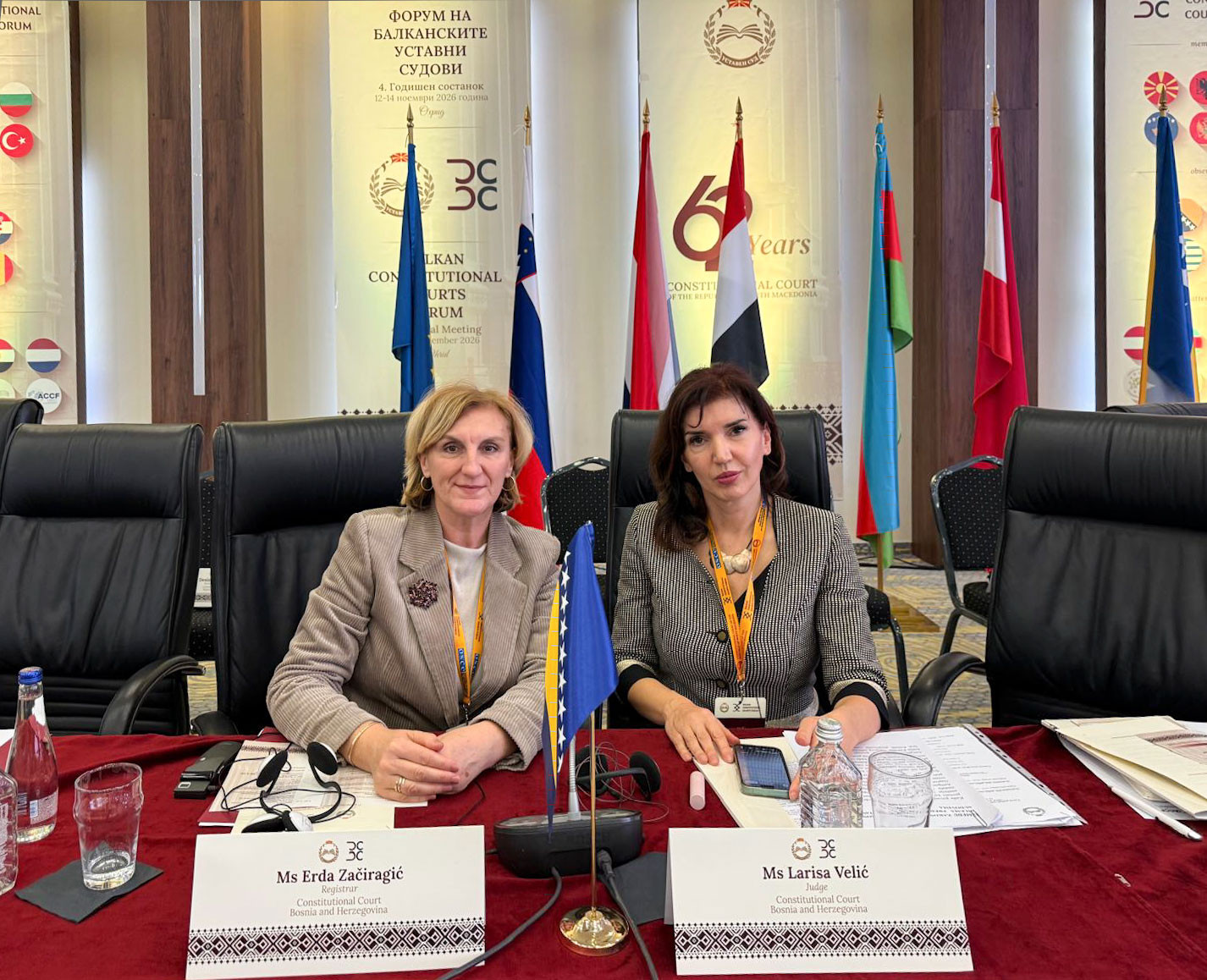
Judge of the Constitutional Court of Bosnia and Herzegovina Prof. Dr. Larisa Velić and Registrar Erda Začiragić participated in the work of the 4th Annual Conference of the Balkan Constitutional Courts Forum, which was held from 12 to 14 November 2026 in Ohrid, North Macedonia. This year's forum was organized by the Constitutional Court of North Macedonia. The Constitutional Court of BiH is not a member of this forum and participated in its work as an observer.
The theme of this year's forum was “Contemporary Challenges of the Rule of Law: The role or Constitutional Courts”. The work of the forum took place in three sessions. Within the third session, Judge Velić presented a paper on the topic “Between Law and Justice: The Antigone Dilemma Before Contemporary Constitutional Courts”.
In her presentation, Judge Velić emphasized, among other things, the key role of constitutional courts – to protect the Constitution and ensure that legal certainty, democracy, and human rights do not depend on political circumstances. In this context, judge Velić emphasised the following: “The constitutional order cannot rest solely on the existence of a Constitution and the formal independence of the constitutional court. It can function only if every institution, within the scope of its competences, assumes responsibility for upholding it. Decisions of constitutional courts are neither recommendations nor opinions that other institutions are free to accept or reject at their discretion. They are final and binding and, as such, must be respected and implemented. This reflects the very essence of the rule of law: an established system in which no one, not even those who hold the highest political office, can decide for themselves which court decisions they will comply with and which they will disregard. The authority of a constitutional court therefore also depends on the effectiveness of the institutional system as a whole, on the willingness and ability of other institutions to ensure that court decisions produce legal effects and that the constitutional order functions effectively. When this responsibility is not fulfilled, it is not merely the authority of a single court that is weakened – it is the Constitution itself, and with it, the legal certainty of every individual. A constitutional democracy demonstrates its strength not merely by having institutions that make decisions in the name of the Constitution, but by having institutions that are willing and able to respect those decisions and ensure their enforcement. The finality of a court decision must not remain merely a legal category on paper; it must be a reality in which the rule of law operates”.
Judge Velić also pointed out that “the universality of human rights loses its meaning if it depends on the identity of the victim, political interests or geopolitical circumstances. It is exactly for this reason that courts must remain faithful to the principles they protect. Justice cannot be selective, just as human rights cannot be universal only when it is politically convenient for us”.