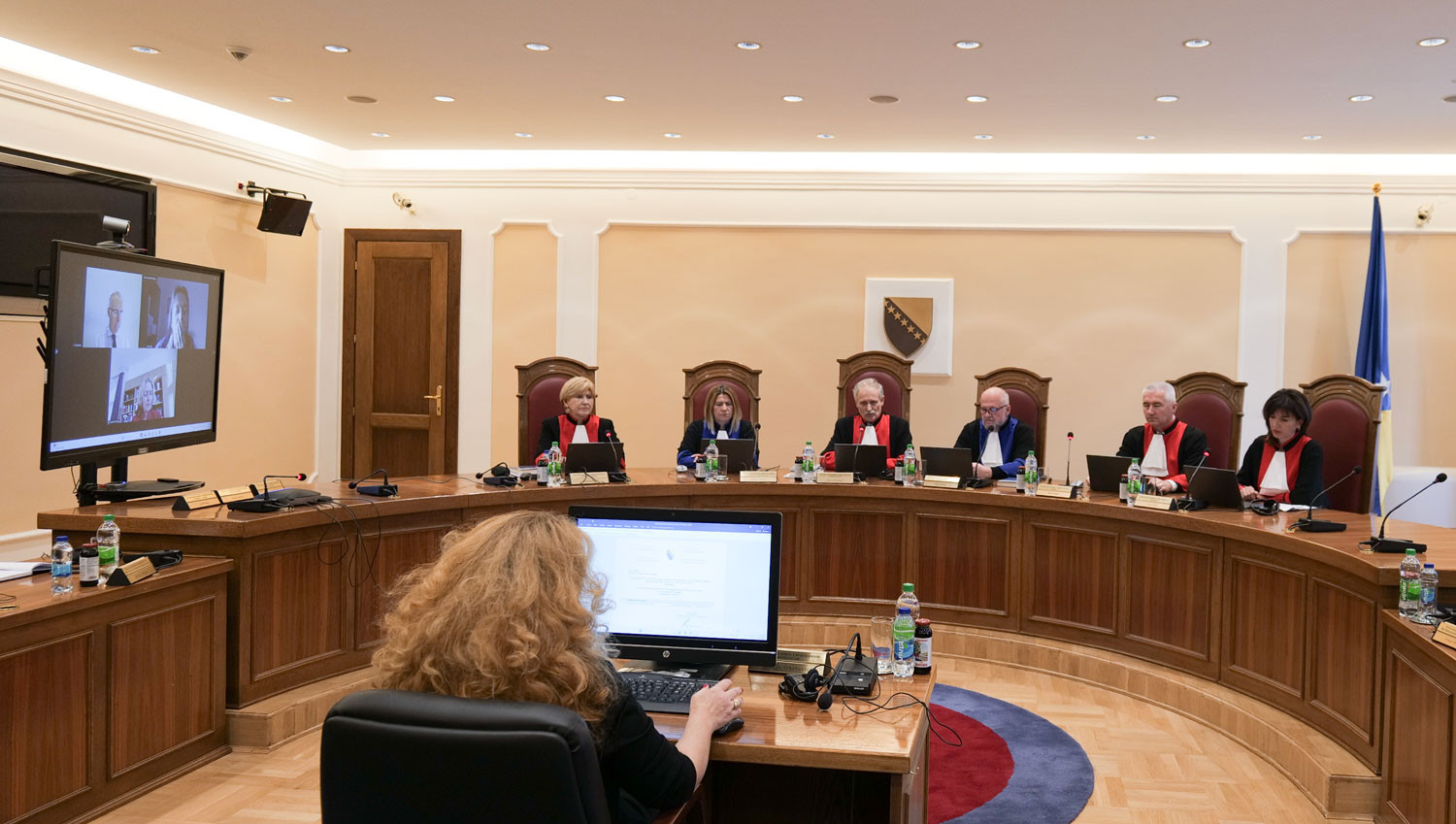
On 4 November 2025, the Constitutional Court held its 10th extraordinary plenary session (online), at which it took Decision on Admissibility and Merits upon appeals no. AP-3722/25 and AP-4095/25 (appellant Milorad Dodik). Given the fact that the same appellant (Milorad Dodik) filed appeals in cases no. AP-3722/25 and no. AP-4095/25 and that the contested decisions relate to the same legal issue, the Constitutional Court, pursuant to Article 32(1) of the Rules of the Constitutional Court, took a decision on the joinder of cases in which it conducted one set of proceedings and took a single decision under no. AP-3722/25.
In Decision on Admissibility and Merits no. AP-3722/25 (Milorad Dodik), the Constitutional Court dismissed as ill-founded the appeal lodged by Milorad Dodik against the judgement of the Court of Bosnia and Herzegovina, no. S1 2 K 046070 25 Kž 2 of 12 June 2025, with regard to Article II(3)(e) of the Constitution of Bosnia and Herzegovina and Article 6(1) of the European Convention for the Protection of Human Rights and Fundamental Freedoms, Article 7 of the European Convention for the Protection of Human Rights and Fundamental Freedoms, and Article 18 of the European Convention for the Protection of Human Rights and Fundamental Freedoms in conjunction with Article 6 of the European Convention for the Protection of Human Rights and Fundamental Freedoms.
The Constitutional Court rejected as inadmissible the appeals lodged by Milorad Dodik with regard to Article II(3)(e) of the Constitution of Bosnia and Herzegovina and Article 6(2) of the European Convention with regard to statements made by public officials during appellant’s trial, for being manifestly (prima facie) ill-founded.
The Constitutional Court rejected as inadmissible the appeal lodged by Milorad Dodik against the ruling of the Court of Bosnia and Herzegovina, no. S1 3 Iž 052766 25 Iž of 18 August 2025, and the decision of the Central Election Commission of Bosnia and Herzegovina no. 06-1-07-939/25 of 6 August 2025, with regard to Article II(3)(e) of the Constitution of Bosnia and Herzegovina and Article 6(1) of the European Convention for the Protection of Human Rights and Fundamental Freedoms and Article 3 of Protocol No. 1 to the European Convention for the Protection of Human Rights and Fundamental Freedoms, for being ratione materiae incompatible with the Constitution of Bosnia and Herzegovina.
As to the allegations of a violation of the right to a fair trial regarding the proceedings after the convicting judgment of the Court of Bosnia and Herzegovina (AP-4095/25), the Constitutional Court has noted in the reasons for its decision that the CEC conducted ex officio the procedure for termination of the appellant’s term of office as the RS President. That procedure was conducted in accordance with the relevant provisions of the BiH Election Law following the second-instance judgment of the Court of BiH in case no. AP-3722/25, i.e. after the convicting judgment against the appellant became final. As it is based on the reasons for the decisions of the CEC and the Court of BiH, the issue of constitutionality and lawfulness of the conduct of the Court of BiH in the criminal proceedings against the appellant was not dealt with in that procedure. The declaratory nature of the contested decision of the CEC (acknowledgement of the termination of the appellant’s term) was also emphasized in the response to the appeal Given that, the Constitutional Court has concluded that neither the appellant’s “civil rights and obligations” nor the “criminal charge” for the purposes of Article 6(1) of the European Court were dealt with in case no. AP-4095/25 and that the safeguards under Article II(3)(e) of the Constitution of Bosnia and Herzegovina and Article 6(1) of the European Convention are therefore not applicable to the procedure conducted before the CEC and the Court of BiH. Consequently, that conclusion excludes the examination of the merits of the appellant’s allegation of bias of a member of the council of the CEC (V.B-P.) who participated in the decision-making of the CEC’s contested decision of 6 August 2025, given that the right to an independent and impartial tribunal for the purposes of the European Convention is a segment of the right to a fair trial. That being said, the Constitutional Court has found that this part of the allegations made in the appeal is ratione materiae incompatible with the Constitution of Bosnia and Herzegovina and the European Convention.
As to the appellant’s complaint of a violation of the principle of no punishment without law under Article 7 of the European Convention, the Constitutional Court has noted that the case involves a new criminal offence, which is incorporated in the criminal justice system by the decision of the High Representative. The Court has further noted that it follows from the case file that the ordinary courts applied and interpreted Article 203a of the Criminal Code of Bosnia and Herzegovina (Failure to Implement Decisions of the High Representative; CC BiH) for the first time in the appellant's case, and therefore one cannot speak of comparative situations/precedents. The substance of the appellant's allegations regarding the application of law relates to the origin of the legal provision applied and thus to the legal status of Christian Schmidt as High Representative and his role in the legal system of Bosnia and Herzegovina, i.e. his power to enact laws. In the circumstances of the specific case, this relates to the powers of the High Representative to adopt the two decisions on 1 July 2023, preventing the entry into force of the Law on Publication of Laws and Other Regulations of the Republika Srpska and the Law on Non-application of Decisions of the Constitutional Court of Bosnia and Herzegovina, and then the decision dated 1 July 2023, enacting the Law on Amendments to the BiH CC, prescribing the criminal offence in respect of which the appellant was prosecuted and convicted.
Regarding the High Representative’s powers to enact laws, the Constitutional Court points out that it has already taken the view in several decisions that the High Representative’s powers follow from Annex 10, the relevant resolutions of the Security Council of the United Nations and the Bonn Declaration, and that these powers and the exercise of these powers are not subject to review by the Constitutional Court (see, for example, Decision on Admissibility and Merits no. U-27/22 of 23 March 2023, paragraphs 72 and 73 with further references; available at www.ustavnisud.ba). In the present case, the Constitutional Court observes that on 1 July 2023 the High Representative intervened in the legal system of Bosnia and Herzegovina and, while substituting himself for the Parliamentary Assembly of Bosnia and Herzegovina, took the Decision Enacting the Law on Amendments to the CC BiH. In the opinion of the Constitutional Court, he therefore acted as a legislative authority of Bosnia and Herzegovina and the aforementioned Amendment to the CC BiH undoubtedly has the legal nature of domestic legislation, the constitutionality of which is not the subject of this appeal. The Constitutional Court therefore considers unfounded the appellant's allegations challenging the legal status of the High Representative and his powers in the context of prescribing the criminal offence under Article 203a of the CC BiH, of which the appellant was found guilty. The Constitutional Court holds that the ordinary courts gave detailed reasons in this regard, on which the criminal proceedings as a whole were centred. Therefore, the Constitutional Court considers that it is beyond doubt that the basic requirement of Article 7 of the European Convention that only a law can prescribe a criminal offence and a punishment, that is, that a criminal offence is clearly defined by law, has been met in the case in question. Similarly, and contrary to the appellant’s complaints, the Constitutional Court considers that the criminal offence of which the appellant has been convicted was in force at the time of signing of the contested decrees.
With respect to the foreseeability and accessibility of the legal norm based on which the appellant was convicted and the relevant security measure imposed, the Constitutional Court points out that in a situation where, as in the case in question, a provision of the Criminal Code is interpreted for the first time with a lawful legal basis and a clear formulation (Article 203a of the CC BiH), the Constitutional Court considers that the ordinary courts have adequately and sufficiently addressed all the disputable issues pertaining to the quality requirements of Article 7 of the European Convention. The Constitutional Court holds that the interpretation of the facts in the disputed judgments do not appear to be arbitrary.
The Constitutional Court also entertained the appellant’s allegation's regarding the independence and impartiality of two judges of the Court of BiH seized of the criminal case against the appellant. The Constitutional Court finds, having examined the allegations of the appellant and the facts and the circumstances of the case, that the impartiality of the judges in this case is not open to doubt, and therefore there was no obligation to disqualify them. Having regard to the foregoing, the Constitutional Court concludes that, in the present case, there has been no violation of the appellant’s right to an independent and impartial tribunal.
With regard to the public nature of the trial, the Constitutional Court observes that the trial was open to the public throughout the proceedings and that a large audience attended the trial. In that regard, the Constitutional Court notes that the ordinary courts gave clear reasons why it was necessary to take certain measures to maintain order in the courtroom. It points out that the Appellate Panel found that there was no interruption in the broadcast on the monitors in the audience area. It is therefore clear, according to the Constitutional Court, that the audience/public could follow the trial unhindered.
With regard to the appellant's allegations that the decision on the delegation of jurisdiction was not decided by the functionally competent court, the Constitutional Court points out that the appellant's contentions on this issue were examined by the Appellate Panel in the contested second instance judgment. The reasons provided in that regard are sufficiently clear and not arbitrary, particularly in view of the fact that it was an issue that had been decided previously by a final decision. The Constitutional Court points out that the court before which the appellant was tried has all competences for trial as any other ordinary court. It is a court established by law in which professional judges adjudicate cases and whose material jurisdiction includes determining of the appellant's criminal liability under Article 203a of the CC BiH. The Constitutional Court therefore holds that these allegations of the appellant are also unfounded.
The Constitutional Court also determined that the condition of the “fairness” principle has been fulfilled in the present case, which principle requires that all evidence must normally be produced in the presence of the accused at a public hearing with a view to adversarial argument. The Constitutional Court could not conclude that by the way in which they conducted the evidentiary proceedings in this criminal matter, the ordinary courts went beyond the scope of their discretion of free evaluation of the evidence adduced in the proceedings, or that “equality of arms” was compromised, which would have resulted in a violation of Article 6(1) of the European Convention.
Furthermore, the Constitutional Court considers that in the reasons given in the disputed decisions the ordinary courts have not failed to address in detail all the appellant’s arguments/complaints of essential importance to the outcome of the proceedings in the case in question and that the courts have given relevant and sufficient grounds in support of their determination. The Constitutional Court has also entertained other numerous submissions made in the appeal in the context of the right to a fair trial, but found that they do not raise issues requiring a separate detailed consideration. Based on the foregoing, the Constitutional Court considers that the circumstances surrounding the case in question, in the light of the foregoing considerations and findings, do not give the impression that the right to a fair trial was violated in the criminal proceedings against the appellant viewed as a whole.
In the light of the Constitutional Court's determination in the present case, it has been decided that there is no need to address the appellant's motion for an interim measure.
Note: The Constitutional Court will soon publish the full text of the decision on the Court’s official website.