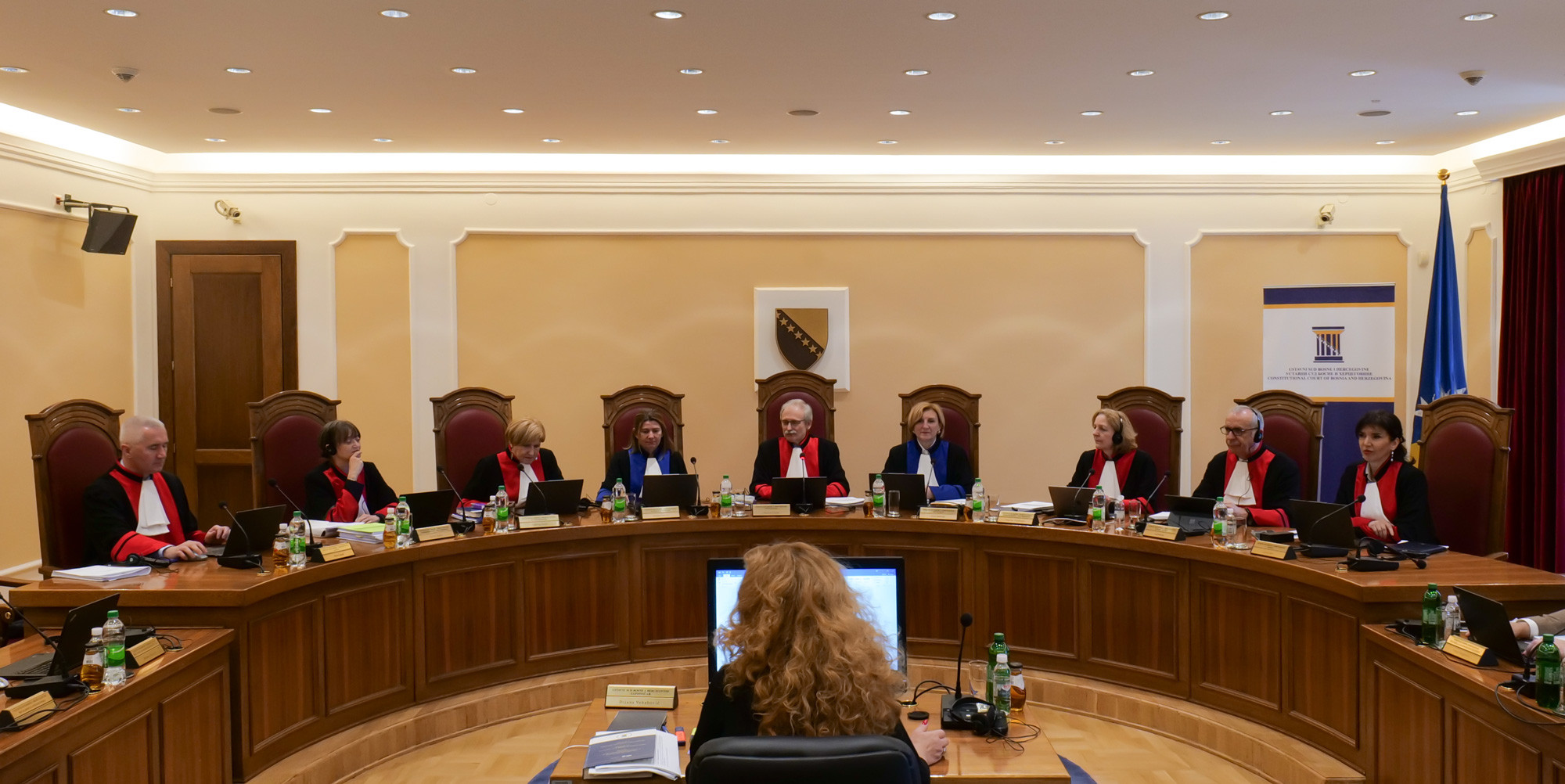
On 26 and 27 March 2026, the Constitutional Court of Bosnia and Herzegovina held its 168th plenary session, at which it decided requests for constitutional review and a number of appeals. In addition, the Constitutional Court decided a number of issues relevant to the work of the Constitutional Court.
Of the decisions adopted at the plenary session, the Constitutional Court singles out the following:
U-1/25 – In this case, the Constitutional Court decided a request of Mr. Kemal Ademović, Deputy Chair of the House of Peoples of the Parliamentary Assembly of Bosnia and Herzegovina, seeking a review of constitutionality of Article 6(1)(1), Article 8(3)(6), Article 141(5) and (6), Article 141a (3) and (4) and Article 146(1) of the Law on Police and Internal Affairs of the Republika Srpska (Official Gazette of the Republika Srpska, 57/16, 110/16, 58/19, 82/19, 18/22, 55/23 and 48/24). In this case, the Constitutional Court decided as follows:
- The provisions of the Law on Police, more specifically, Article 141(5), in the part reading “digital signing and issuing qualified digital certificates and carry out document personalization”, Article 141(6), in the part reading “and Article 141a of this law, as well as the infrastructure protection referred to in paragraph 5 of this article”, and Article 141a (4) of the Law on Police and Internal Affairs are not compatible with Article III(3)(b) of the Constitution of Bosnia and Herzegovina because Republika Srpska, in enacting these provisions of the Law on Police, failed to harmonize them with the relevant provisions of the BiH Law on Agency, BiH Law on Identity Card and BiH Law on Travel Documents, whereby the Agency has responsibility in the field of digital signature and personalization of identification documents, and the enactment of relevant by-laws specifying this field.
- Article 146(1) of the Law on Police is not compatible with Article III(3)(b) and III(1)(g) of the Constitution of Bosnia and Herzegovina is not compatible with Article III(3)(b) and III(1)(g) of the Constitution of Bosnia and Herzegovina because the Directorate is responsible for coordination of the police bodies of Bosnia and Herzegovina and related bodies in Bosnia and Herzegovina with appropriate foreign and international bodies.
- Article 6(1)(1) of the Law on Police is compatible with Article III(3)(b) of the Constitution of Bosnia and Herzegovina because the RS Ministry of the Interior is authorized to perform specific activities related to the unique identification number, identity cards and travel documents.
- Article 8(3)(6) of the Law on Police is compatible with Article III(3)(b) of the Constitution of Bosnia and Herzegovina because it does not relate expressly to the duties under the scope of responsibilities of the Agency but rather prescribed in a general manner the protection of information and communication structure.
- Article 141(5) of the Law on Police, in the part reading “including the police ID referred to in Article 24 of this law and the identification document referred to in Article 69 of this law in accordance with applicable law”, is not incompatible with the provisions of the BiH Law on Agency because it involves the personalization of documents for police and other employees, which is not regulated in the BiH Law on Agency.
- Article 141(6) of the Law on Police, in the part reading “The RS Minister of the Interior shall issue a rulebook regulating the creation of a protection system for the registers referred to in Article 8(3)(6), registers referred to in paragraph 1 of this article” is not incompatible with the provisions of the BiH Law on Agency, given the aforementioned findings regarding Article 8(3)(6), i.e. because it does not raise an issue of consistency with the BiH Law on Agency.
- Article 141a (3) of the Law on Police is not incompatible with Article 8 of the BiH Law on Agency and Articles 19 and 26 of the BiH Law on Travel Documents because there is no longer any option for citizens to use the infrastructure referred to in Article 141(5) of the Law on Police, but only the infrastructure established by the Agency, following the finding that the relevant part of Article 141(5) of the Law on Police is not compatible with Article III(3)(b) of the Constitution of Bosnia and Herzegovina.
U-13/25 – In this case, the Constitutional Court decided on a request filed by eleven members of the House of Representatives of Bosnia and Herzegovina, for deciding a dispute with the Entity of Republika Srpska, the National Assembly of the Republika Srpska, in respect of the adoption of the Decision on Adopting the Draft Constitution of the Republika Srpska (Official Gazette of the Republika Srpska, 23/025). The applicants argued that the Decision on Adopting the Draft Constitution of the Republika Srpska was incompatible with Articles I(1), I(2), III(3)(b) and VI(5) of the Constitution of BiH. The Constitutional Court established that there was a dispute between Bosnia and Herzegovina and Republika Srpska concerning the Decision on Adopting the Draft Constitution of the Republika Srpska and that the Decision on Adopting the Draft Constitution of the RS was not compatible with Articles I(2), III(3)(b) and VI(5) of the Constitution of Bosnia and Herzegovina, because the provisions forming the basis of the constitutional order of Republika Srpska were not compatible with the provisions of the Constitution of Bosnia and Herzegovina and with the final and binding decisions of the Constitutional Court of Bosnia and Herzegovina. Pursuant to Article 61(3) of the Rules of the Constitutional Court of Bosnia and Herzegovina, the quashed Decision on Adopting the Draft Constitution of the Republika Srpska shall be rendered ineffective on the next day following the date of publication of the decision of the Constitutional Court in the Official Gazette of Bosnia and Herzegovina. Pursuant to Article 61(1) of the Rules of the Constitutional Court of Bosnia and Herzegovina, the National Assembly of the Republika Srpska, all competent authorities in the Republika Srpska, as well as all official and responsible persons within those institutions are hereby ordered to suspend all activities taken on the basis of the Decision on Adopting the Draft Constitution of the Republika Srpska.
U-35/25 – Deciding upon the request of Darko Babalj, the First Deputy Chairman of the House of Representatives of the Parliamentary Assembly of Bosnia and Herzegovina for a review of the constitutionality of the Law on Political Organizations Financing (Official Gazette of the Republika Srpska, 45/25), the Constitutional Court concluded that the contested law is not compatible with Article II(3)(i) of the Constitution of Bosnia and Herzegovina and Article 11 of the European Convention for the Protection of Human Rights and Fundamental Freedoms (which guarantees the right to freedom of association), as the abolition of budgetary financing constitutes a disproportionate interference which, in the absence of evidence of a “pressing social need”, undermines the principle of equal opportunities and political pluralism as foundations of freedom of association in a democratic society. The request of Darko Babalj for a review of the lawfulness of the Law on Political Organizations Financing (Official Gazette of the Republika Srpska, 45/25), with regards to Articles 1, 2, 4, 5, 10, 11, and 16 of the Law on Execution of the Budget of the Republika Srpska for 2025, and Articles 3, 7, 10, 14, 15, 20, 30, 31, 38, and 39 of the Law on the Budgetary System of the Republika Srpska, was rejected for lack of jurisdiction of the Constitutional Court. The Constitutional Court pointed out that, in the present case, the laws in question were enacted by the National Assembly of the Republika Srpska, and therefore the matter does not concern two institutions of Bosnia and Herzegovina that could have competing jurisdictions over the same matter; consequently, no dispute within the Court’s jurisdiction arises in that regard.
U-37/25 – In this case, deciding upon the request of 31 delegates of the National Assembly of the Republika Srpska for a review of the constitutionality of the Decision on the establishment of an office and the procedure of appointment of a chief negotiator and deputies of the chief negotiator of Bosnia and Herzegovina for conducting negotiations on accession to the European Union (Official Gazette of Bosnia and Herzegovina, 68/25), the Constitutional Court concluded that the contested decision is not compatible with Articles I(2) and IV(3)(c) of the Constitution of Bosnia and Herzegovina. Following the standards that arise from Article I(2) of the Constitution of BiH, the Constitutional Court observes, inter alia, that the House of Peoples did not approve the disputed Decision, as required by Article IV(4)(a) of the Constitution of BiH stipulating that all legislation shall require the approval of both chambers. Therefore, the Decision adopted by one chamber of a legislative body in the exercise of the responsibilities under Article III(1) of the Constitution of BiH does not constitute a decision of the Parliamentary Assembly within the meaning of Article IV(4)(a) of the Constitution of BiH. Accordingly, such Decision cannot produce legal effect for it is not compatible with Article I(2) taken in conjunction with Article IV(3)(c) of the Constitution of BiH. Ruling on the legal effect of its decision, in accordance with Article 61(1) of the Rules of the Constitutional Court, the Constitutional Court found that the contested Decision is null and void ab initio. Furthermore, bearing in mind that the matter concerns an important issue relating to the fulfilment of the obligations of the institutions of Bosnia and Herzegovina in respect of the requirements for the initiation of the accession negotiation process with the European Union, which have not yet been fulfilled, the Constitutional Court, pursuant to Article 72(4) of its Rules, ordered the Parliamentary Assembly, within six months from the date of delivery of this decision, to regulate, in accordance with its competences, the procedure for the appointment of the chief negotiator and deputy chief negotiator of Bosnia and Herzegovina for conducting accession negotiations with the European Union, as well as the establishment of the office of the chief negotiator and the deputy chief negotiator of BiH.
U-39/25 – In this case, the Constitutional Court concluded that the contested provisions of Article 54(1)(m) and Article 62(3) and (4) of the Law on Higher Education of the Zenica-Doboj Canton (Official Gazette of the Zenica-Doboj Canton, 12/22, 15/24 and 5/25) are incompatible with Articles 4 and 63 of the Framework Law on Higher Education in Bosnia and Herzegovina and with Article I(2) of the Constitution of Bosnia and Herzegovina. They are incompatible as they do not provide adequate protection against arbitrariness and are contrary to the principle of academic self-management and university autonomy because, in substance, the reasons for which the management board may dismiss the rector are prescribed normatively broadly and imprecisely and allow for a broad discretionary right of public authorities to dismiss the rector. This is the only prescribed sanction without the possibility of imposing any more lenient measure. In contrast, the Constitutional Court concludes that paragraphs 1 and 2 of Article 52 of the Law on Higher Education are compatible with Articles 4, 14, 15, 16, 18, 22 and 63 of the Framework Law and Article I(2) of the Constitution of BiH. Namely, the fact that the majority of members of the management board are representatives of the founders (with the president of that body being appointed from amongst those members) cannot per se lead to a violation of academic self-government and autonomy if the powers of the management board do not encroach on the sphere of academic issues, i.e. issues that are under the exclusive authority of the academic community and the senate.
U-6/26 – In this case, the Constitutional Court rejected as inadmissible a request filed by eleven members of the House of Representatives of the Parliamentary Assembly of Bosnia and Herzegovina seeking a determination of a dispute between Bosnia and Herzegovina and the Entity of Republika Srpska, concerning the adoption of the Decision on the Appointment of the Prime Minister of the Republika Srpska (Official Gazette of the Republika Srpska, 5/26) and Decision on the Appointment of the Members of the Government of the Republika Srpska (Official Gazette of the Republika Srpska, 5/26), on the grounds that the Constitutional Court of Bosnia and Herzegovina does not have jurisdiction to take a decision. In the reasons for its decision, the Constitutional Court noted that the adoption of the contested decisions did not give rise to a dispute within the meaning of Article VI(3)(a) of the Constitution of Bosnia and Herzegovina, as the matter concerns the regularity of the procedure for appointing the Prime Minister and members of the Government of the Republika Srpska, which is governed by the Constitution of the Republika Srpska, rather than the Constitution of Bosnia and Herzegovina, and falls within the jurisdiction of the Constitutional Court of the RS. This issue in no way calls into question the division of responsibilities among the various levels of government or institutions in Bosnia and Herzegovina that fall within the exclusive jurisdiction of the Constitutional Court of Bosnia and Herzegovina.
Considering the Information on the reactions of parts of the general, professional, political, and other public, which included initiatives seeking to initiate consideration of the “existence of grounds for dismissal” of the judge of the Constitutional Court Marin Vukoja, submitted by the Vice President of the Republika Srpska, Ćamil Duraković, and by Dennis Gratz, a representative in the House of Representatives of the Parliament of the Federation of Bosnia and Herzegovina, in relation to the same matter, the Constitutional Court emphasized that it examines issues of the professional and ethical conduct of judges with particular care and responsibility, bearing in mind the importance of maintaining public confidence in the integrity and reputation of the Court.
The Constitutional Court pointed out that judges are obligated, in the exercising their duties, both in their public and private life and conduct, to safeguard the integrity and reputation of the Constitutional Court, as well as their own personal judicial integrity and reputation.
All decisions adopted at the plenary session shall be delivered to the applicants/appellants within one month and shall be published as soon as possible on the official website of the Constitutional Court of Bosnia and Herzegovina.